Free and open-source issue trackers for teams with AI agents (2026)
The best free issue tracker depends on whether you want to run a server. Sourced as of Nov 2, 2026: GitHub Issues, Plane, Gitea, Forgejo, Redmine, Taiga, OpenProject, and the free tiers of Linear and Jira, compared on free-tier limits, the true cost of self-hosting, MCP and CLI support for agents, and agent billing.
The best free issue tracker for most teams is GitHub Issues if your code is on GitHub: it costs $0 with no published cap on issues or collaborators, and it has an official MCP server and CLI for agents. The best free Jira alternative is Jira's own Free plan for up to 10 users, or Plane's cloud Free plan for up to 12. The best free Linear alternative is Linear Free, if 250 issues is enough; past that, Plane or GitHub Issues. The best open-source issue tracker for AI agents is Gitea, the only self-hosted tracker here with both an official MCP server and an official CLI. Self-hosting is free to license but not free to run: on our base assumptions, a small server plus admin time costs about $1,500 to $2,000 in year one, and $840 to $3,360 across our low and high admin-time scenarios. That cost is mostly fixed: it does not grow much with the team.
Radial is not free and not open source, and it cannot be self-hosted. It costs $50 per user per year, agents cost $0, and there is no server to run. For a 10-person team that is $500 a year, against roughly $1,500 to self-host on our base assumptions.
Every fact below comes from the vendor's pricing page, docs or official repository, checked on Nov 2, 2026, linked inline. Where a vendor does not say, we write "not published". The tables are also published as data: free tiers CSV, agent support CSV and self-hosting costs JSON, each with a source URL and a checked date.
#Free tiers and their limits
| Tracker | Free option | Limits on the free option | Cheapest paid hosted plan |
|---|---|---|---|
| GitHub Issues | GitHub Free includes Issues and Projects | None published for issues. Private repos get a "limited feature set", which names branch and pull request features, not issues. | GitHub Team: $4 per user per month (pricing) |
| Plane | Cloud Free, and the self-hosted Community Edition (AGPL-3.0) | Cloud Free: 12 users. Community Edition: "free with no user limits" (open source), with the same features as cloud Free; epics, SSO, workflows and the GitHub integration are paid. | Pro: $6 per user per month billed annually, $8 monthly |
| Gitea | Self-hosted (MIT), and free hosting on gitea.com for open-source projects | Self-hosted: no user or repo limits. Projects boards are marked partial in Gitea's feature comparison. | Gitea Cloud: $19 per user per month list, shown at $9.50 with a discount "for non-profits, and small companies" |
| Forgejo | Self-hosted (GPL v3+ since v9.0), and Codeberg for free and open-source projects | Self-hosted: no limits. Codeberg hosts only openly licensed projects (terms) and wrote on 2026-07-23 that projects built by autonomous LLM agents may not be welcome (post, checked on Nov 2, 2026). | None from the project |
| Redmine | Self-hosted (GPL v2) | None. Latest version 7.0.3, released 2026-11-01 (checked on Nov 2, 2026). | None from the project |
| Taiga | Cloud Free, and self-hosted (MPL 2.0) | Cloud Free: 1 public and 1 private project, 10 MB storage, unlimited users | Cloud Enthusiast: €5 per month flat for the workspace (€50 billed yearly), unlimited users, 5 public and 5 private projects, 100 MB. Basic: €20 per month (€200 yearly), unlimited projects, 500 MB. |
| OpenProject | Self-hosted Community edition (GPL v3) | Community: no user minimum. No free cloud plan, only a 14-day trial. | Basic: €5.95 per user per month, 25 users minimum (€1,785 a year at the minimum; minimum checked on Nov 2, 2026) |
| Linear | Linear Free | Unlimited members, 2 teams, 250 issues, 10MB uploads | Basic: $10 per user per month, billed yearly |
| Jira | Jira Free | 10 users. Rovo MCP server capped at 500 calls an hour (Rovo MCP). | Standard: $9.70 per user per month for new purchases from Oct 13, 2026 (renewals may differ; many guides still list the older, lower rate), or $950 a year for 1 to 10 users |
| Radial | None. Radial is paid from the first user. | Not applicable | $50 per user per year, flat, one plan |
Taiga deserves a note: its cloud plans are flat per workspace with unlimited users. Enthusiast is €50 a year for 5 private projects and 100 MB; Basic is €200 a year for unlimited projects and 500 MB, cheaper than any per-seat tracker here once a team passes 5 people. The catch is the storage cap and no MCP server or CLI for agents.
The free tiers table as CSV: free-and-open-source-issue-trackers-free-tiers.csv.
#Agent and MCP support
An agent works through an issue tracker in one of three ways: an MCP server, a CLI, or the tracker's API. Every tracker here has an API: Linear's is GraphQL, GitHub offers REST and GraphQL, and the rest are REST. The table shows which ship an official MCP server and an official CLI, and whether an agent costs a seat.
| Tracker | Official MCP server | Official CLI for issues | Are agents billed? |
|---|---|---|---|
| GitHub Issues | Yes, "provided and maintained by GitHub", hosted at api.githubcopilot.com/mcp/, with an issues toolset | Yes: gh issue (manual) | Not published. GitHub Apps are not on the billed-user list. Assigning an issue to Copilot's cloud agent needs a paid Copilot plan from October 28, 2026 (docs). |
| Plane | Yes, "Plane's Official Model Context Protocol Server". Hosted at mcp.plane.so for the cloud; self-hosted instances run it locally, because the hosted service "cannot reach private Plane instances". | Not published. Plane's only official CLI manages a Commercial Edition server. | Self-hosted Community Edition: no seats to bill. Cloud: not published. |
| Gitea | Yes, gitea-mcp, covering issues, labels, milestones, projects and pull requests | Yes: gt, which its README calls "the new official CLI for Gitea" (repo). The older tea README still calls tea official, so both claim the title (checked on Nov 2, 2026). | Self-hosted: no seats to bill. Gitea Cloud: not published. |
| Forgejo | Not published. forgejo-mcp exists as a third-party project. | No. fj covers issues but lives in the community forgejo-contrib org. | Self-hosted: no seats to bill |
| Redmine | Not published (a search of redmine.org for MCP returns 0 results) | Not published. REST API in XML and JSON. | Self-hosted: no seats to bill |
| Taiga | Not published | Not published. REST API. | Cloud plans are flat per workspace, so no. Self-hosted: no seats to bill. |
| OpenProject | Built in at /mcp, but "an Enterprise add-on" on Professional and up (€10.95 per user per month, 25 users minimum). Not in Community. | No. openproject-cli exists but is "unsupported software". | Community: no seats to bill. Enterprise: not published. |
| Linear | Yes, hosted at mcp.linear.app/mcp. No plan requirement published. | No official issue-management CLI. Agents use the GraphQL API or community CLIs. | No: "Agents are not counted as billable seats in Linear" (docs) |
| Jira | Yes, Rovo MCP, on every Cloud plan: 500 calls an hour on Free, 1,000 on Standard. Enriched calls draw Rovo credits. | Yes: acli (docs) | Not if the agent uses a person's token or a service account (5 free) |
| Radial | Yes, hosted, with OAuth | Yes: radial | No. Agent members never count as seats, and nothing is metered. |
So the best open-source issue tracker for AI agents, by tooling, is Gitea: an official MCP server and an official CLI, both maintained by the project. Plane is second, with an official MCP server and no issue CLI. OpenProject has an MCP server only on paid Enterprise plans. Forgejo, Redmine and Taiga leave agents on the REST API or community tools.
The agent support table as CSV: free-and-open-source-issue-trackers-agent-support.csv.
#The true cost of self-hosting
Self-hosted trackers cost $0 to license and do not bill agents. The cost is the server and the time someone spends keeping it running.
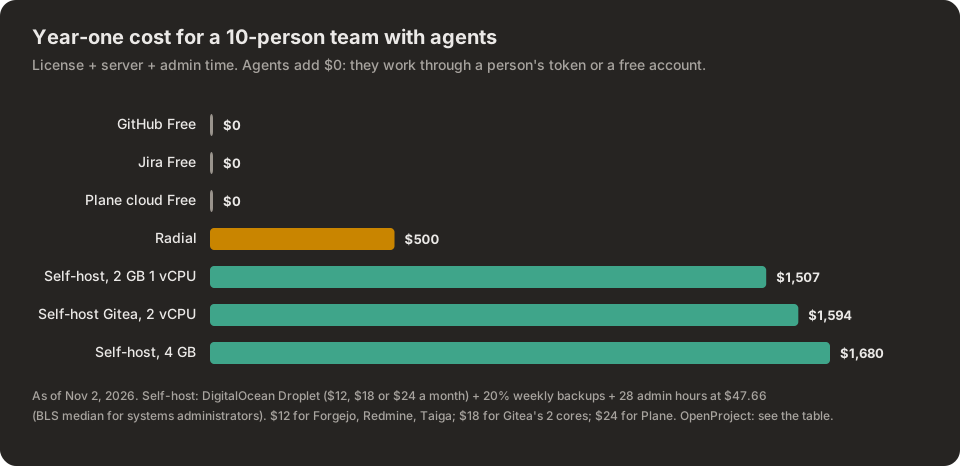
The chart shows year-one cost for a 10-person team with agents, on our base admin-time assumption: GitHub Free, Jira Free and Plane cloud Free at $0, Radial at $500, self-hosting on a 2 GB 1 vCPU server at $1,507, self-hosting Gitea on a 2 vCPU server at $1,594, and self-hosting on a 4 GB server at $1,680.
| Tracker | Published minimum hardware | Server we priced | Server + backups per year | Year one with admin time | Year two on |
|---|---|---|---|---|---|
| Gitea | "2 CPU cores and 1GB RAM is typically sufficient for small teams" (docs) | 2 GB Droplet with 2 vCPUs, $18 a month | $259.20 | $1,593.68 | $1,403.04 |
| Forgejo | Not published | 2 GB Droplet, $12 a month | $172.80 | $1,507.28 | $1,316.64 |
| Redmine | Not published; needs Ruby, Rails 8.1 and a database (install guide) | 2 GB Droplet, $12 a month | $172.80 | $1,507.28 | $1,316.64 |
| Taiga | "At least 1GB RAM" for a source install (docs) | 2 GB Droplet, $12 a month | $172.80 | $1,507.28 | $1,316.64 |
| Plane | 2 cores, "4GB (8GB recommended for production)" (docs) | 4 GB Droplet, $24 a month | $345.60 | $1,680.08 | $1,489.44 |
| OpenProject | Quad-core CPU, 4096 MB RAM, 20 GB disk (docs) | 8 GB Droplet with 4 vCPUs, $48 a month | $691.20 | $2,025.68 | $1,835.04 |
Assumptions:
- Server: DigitalOcean Basic Droplets at $12 (2 GB, 1 vCPU), $18 (2 GB, 2 vCPUs, for Gitea's "2 CPU cores"), $24 (4 GB) and $48 (8 GB, 4 vCPUs) a month, plus weekly backups at "20 % (Weekly) ... of Droplet cost" (Droplet pricing). Cheaper hosts exist: Hetzner lists a 4 GB CX23 at €5.99 a month before VAT, marked "not available" when we checked on Nov 2, 2026 (Hetzner). The database runs on the same server.
- Admin time: our assumption, not a vendor figure, and the number that moves the result most. Base: 4 hours to install, then 2 hours a month for upgrades, backup checks, TLS renewal and OS patches: 28 hours in year one, 24 after. Low: 2 hours to install and 1 a month (14 hours, then 12). High: 8 hours to install and 4 a month (56 hours, then 48). No vendor publishes an admin-hours figure.
- Hourly rate: $47.66, the 2025 median wage for network and computer systems administrators (BLS). The 2025 median for software developers, quality assurance analysts and testers combined is $64.44 an hour, and for software developers alone $135,980 a year (BLS), so if a developer does the work, the time costs more.
- Arithmetic: year one = server x 1.2 x 12 + 28 x $47.66. For Forgejo: $12 x 1.2 x 12 = $172.80, plus $1,334.48 = $1,507.28.
- Not included: your own hours on a bad upgrade or a restore, a staging server, SSO, email delivery, and tax.
| Server | Year one: low (14 h) | Year one: base (28 h) | Year one: high (56 h) | Year two on: low, base, high (12, 24, 48 h) |
|---|---|---|---|---|
| $12 a month (Forgejo, Redmine, Taiga) | $840.04 | $1,507.28 | $2,841.76 | $744.72, $1,316.64, $2,460.48 |
| $18 a month (Gitea) | $926.44 | $1,593.68 | $2,928.16 | $831.12, $1,403.04, $2,546.88 |
| $24 a month (Plane) | $1,012.84 | $1,680.08 | $3,014.56 | $917.52, $1,489.44, $2,633.28 |
| $48 a month (OpenProject) | $1,358.44 | $2,025.68 | $3,360.16 | $1,263.12, $1,835.04, $2,978.88 |
Both self-hosting tables are in free-and-open-source-self-hosting-costs.json, with the assumptions and a source URL for every price.
Admin time is 66% to 89% of the year-one bill in the base scenario. If running the server costs you nothing (it is your hobby, or a platform team already runs one), self-hosting costs $172.80 to $691.20 a year. That beats Radial from 4 people on a $12 server ($172.80 against $200), from 7 on Plane's $24 server and from 14 on OpenProject's. It never beats a free tier that fits: GitHub Free stays at $0, and Radial costs $50 to $150 for 1 to 3 people.
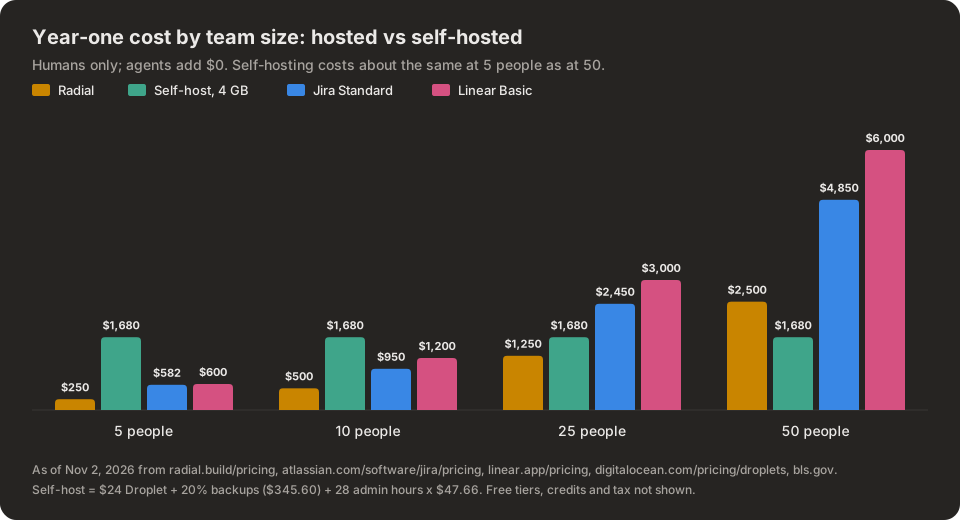
The chart shows year-one cost by team size, base scenario. At 5 people: Radial $250, self-hosting on a 4 GB server $1,680, Jira Standard $582, Linear Basic $600. At 10: Radial $500, self-hosting $1,680, Jira $950, Linear $1,200. At 25: Radial $1,250, self-hosting $1,680, Jira $2,450, Linear $3,000. At 50: Radial $2,500, self-hosting $1,680, Jira $4,850, Linear $6,000.
Self-hosting is a fixed cost, so it gets cheaper per person as the team grows. In the base scenario, Radial costs less than self-hosting Plane in year one up to 33 people ($1,650 against $1,680.08), and up to 29 people from year two ($1,450 against $1,489.44). In the low scenario the year-one break-even falls to 20 people ($1,000 against $1,012.84); in the high scenario it rises to 60 ($3,000 against $3,014.56). Above the break-even, self-hosting costs less in money and admin time combined.
Radial's own admin time is not zero either: someone adds and removes members, mints and revokes API keys for agents, and runs the migration. We have not measured those hours, so the comparison above counts them as $0, which flatters Radial.
#The best free Jira alternative
Start with Jira Free if you have 10 users or fewer: it is Jira, at $0, and agents can use the Rovo MCP server at up to 500 calls an hour or acli. If you want to leave Jira, the free options that fit a small team are:
- Plane cloud Free for up to 12 users, with an official MCP server. Plane plans work in cycles on boards, close to how Jira teams work, and you can move to the self-hosted Community Edition later with no user limit.
- GitHub Issues if your code is on GitHub and a list of issues with labels, milestones and Projects boards is enough.
- OpenProject Community if you need Gantt charts and are willing to run a quad-core server.
For a paid comparison, see Radial vs Jira.
#The best free Linear alternative
Linear Free has unlimited members but stops at 250 issues and 2 teams. A team with coding agents can file 250 issues in weeks. Past that limit:
- Plane is the closest in feel: cycles, a keyboard-driven web app, and an official MCP server. Free in the cloud for 12 users, or self-hosted with no user limit.
- GitHub Issues has no published issue cap on GitHub Free, plus an official MCP server and
gh. - Gitea if you self-host and want agent tooling: an official MCP server and the
gtCLI.
For a paid comparison, see Radial vs Linear.
#Where Radial fits: near-free, not free
Radial is a paid, hosted, closed-source issue tracker. We list it here because it is the near-free option for a team that runs agents and does not want to run a server:
- $50 per user per year, flat. One plan, billed yearly, no free tier and no monthly plan.
- Agents cost $0. Agent members never count as seats, and nothing is metered: no credits, no rate-limited free plan.
- No self-hosting work, and no self-hosting option. No server, backups or upgrades to run, but also no way to move Radial onto your own servers. Your data is stored in the United States, primarily in an AWS US region. The exit is
radial export, JSON or CSV: issues, comments, teams, statuses, labels, projects, cycles and members (attachment files, relations and build records are fetched separately). - Built for agents. A first-party CLI (
radial), a hosted MCP server and a REST API.
What is open: the rd-* agent skills, which drive Radial from Claude Code and other agents, are MIT-licensed in a public repository, github.com/BrainGridAI/radial, which also hosts the CLI's releases. The Radial app is not open source, and Radial cannot be self-hosted.
Where Radial is not the cheapest:
- Free tiers cost $0. GitHub Free, Jira Free (10 users), Plane cloud Free (12 users) and Linear Free (250 issues) beat any paid plan if they fit.
- Taiga cloud Basic is €200 a year for unlimited users, cheaper than Radial past 5 people, if you can work without an MCP server or CLI.
- Self-hosting wins past about 30 people on our base assumptions (20 to 60 across the low and high scenarios). If admin time is free to you, it wins from 4 to 14 people, depending on the server.
- GitHub Team is $48 per user per year against Radial's $50.
For the full paid comparison across eight trackers, read what a cost-effective issue tracker is. For Radial's plan, see Radial pricing.
#How we compared
We compared from docs. On Nov 2, 2026, we read each vendor's pricing page, docs and official repositories, and recorded every figure with its URL and a short quote. "Official" MCP servers and CLIs are ones the vendor or project builds or maintains; community tools are named as such. Self-hosting costs use DigitalOcean list prices and the BLS median wage, with admin hours as our stated assumption and the arithmetic in the table. We did not install or load-test any tracker. Our agent-capability scores for Jira and Linear, and how we scored them, are in the methodology sections of Radial vs Jira and Radial vs Linear; the raw runs are not published.
#FAQ
#What is the best free issue tracker?
GitHub Issues, if your code is on GitHub: $0 on GitHub Free with no published cap on issues or collaborators, an official MCP server and the gh CLI. If you are not on GitHub, Plane's cloud Free plan covers 12 users and Jira Free covers 10. If you will run a server, Gitea, Plane Community Edition and OpenProject Community are free with no user limits.
#What is the best open-source issue tracker for AI agents?
Gitea, as of Nov 2, 2026: it has an official MCP server (gitea-mcp) and an official CLI (gt). Plane has an official MCP server but no CLI for issues. OpenProject's MCP server is an Enterprise add-on, not in the free Community edition. Forgejo, Redmine and Taiga have no official MCP server, so agents use their REST APIs.
#What is the best free Jira alternative?
For 10 users or fewer, Jira Free itself. To leave Jira, Plane is the closest in structure: free in the cloud for 12 users, or self-hosted with no user limit, with an official MCP server. GitHub Issues is free if your code is on GitHub. OpenProject Community is free to self-host if you need Gantt charts.
#What is the best free Linear alternative?
Linear Free, until you pass 250 issues or 2 teams. After that, Plane is the closest in feel and is free for 12 users in the cloud or unlimited users self-hosted. GitHub Issues has no published issue cap on GitHub Free.
#How much does it cost to self-host an issue tracker?
On our base assumptions, about $1,500 to $2,000 in year one and $1,300 to $1,850 a year after; $840 to $3,360 in year one across our low and high admin-time scenarios. The server costs $172.80 to $691.20 a year on DigitalOcean with weekly backups; the rest is admin time (28 hours in year one in the base case) at $47.66 an hour, the BLS median wage for systems administrators. If the admin time costs you nothing, it is only the server.
#Do free issue trackers charge for AI agents?
Self-hosted trackers have no seats, so an agent account costs nothing beyond the server. Linear says agents are not billable seats, and Jira does not bill service accounts (5 free). GitHub does not publish a rule for agent accounts, though GitHub Apps are not billed users. Jira's enriched Rovo MCP calls draw Rovo credits on paid plans, and Copilot's cloud agent needs a paid Copilot plan.
#Is Radial free or open source?
No. Radial costs $50 per user per year, flat, with agents free and nothing metered, and it is hosted only: it cannot be self-hosted. Its rd-* agent skills are MIT-licensed in a public GitHub repository; the app is closed source.
The team behind Radial, the fast, CLI-first issue tracker that lets your own agents work for free. We write about plain software, speed as respect, and bringing your own agent.
Track issues like it’s 2019. Ship like it’s 2026.
An issue tracker. That’s it. Your agents ride free.
Keep reading
Radial vs Linear for coding agents: CLI, MCP and prices compared from docs (2026)
Linear has a free tier, a hosted MCP server with an unpublished tool list, no official issue-management CLI, and its own Linear Agent billed in AI credits. Radial is $50 per user per year, flat, with a first-party CLI, a 45-tool MCP server, and no agent of its own. Side by side, compared from docs, with costs for four team sizes and where Radial loses.
What is a cost-effective issue tracker? Prices for 8 trackers with AI agents (2026)
A cost-effective issue tracker charges for the people, not the agents, and adds no meter. Sourced prices as of Nov 2, 2026 for Radial, Jira, Linear, GitHub Issues, Asana, ClickUp, Shortcut and Plane: free tiers, per-seat prices, agent billing, hidden costs, and the cost at 1, 10 and 25 people with agents.
Linear vs Jira, and the third option neither names
An honest Linear vs Jira comparison: Linear wins on speed and developer experience, Jira wins on enterprise breadth and customization. Then the question both leave open: why does the price keep moving, and where is the meter?